Oct 21, 2025
A home is more than just a place for furniture; it's a space to fill with memories, laugh with your children, feel safe with your family, and recharge after a hard day's work. Therefore, housing in Riyadh is not viewed as just a real estate unit, but as part of a life journey that begins with choosing the right neighborhood and continues with the details of daily living.
The capital expands day after day with its modern projects, new roads, and vibrant neighborhoods. But with this expansion, people increasingly ask: What is the house price in Riyadh? And how can one find a home that balances dreams with financial capability? This is where the real challenge begins, especially since everyone enters this journey with different motivations: the young man about to marry seeks a stable start, the frequently moving father wants to settle his family in a comfortable neighborhood, and the investor carefully monitors areas to choose a place that preserves his capital long-term.
A set of fundamental factors play a key role in determining house prices in Riyadh. The market doesn't move randomly but is influenced by a mix of location, services, construction quality, and supply and demand dynamics.
Location is the primary and strongest factor controlling house prices in Riyadh. Northern districts like Al Narjis, Al Yasmin, and As Sahafah attract those wanting to live near major malls, universities, and vital centers, leading to higher prices. In contrast, prices in the southern part of the capital tend to be lower, as some areas are still under development.
Housing costs increase with the unit's area and number of rooms. A one-bedroom apartment is usually an economical choice, while larger 3 or 4-bedroom apartments attract families seeking more space and comfort. Therefore, family housing prices in Riyadh are higher than individual or shared housing.
Good services directly increase a property's value. Proximity to schools, hospitals, and commercial centers makes any neighborhood more attractive, thus raising prices. For example, in the north, demand is high due to proximity to major projects like Riyadh Park or King Saud University.
Buyers pay a higher price for durable building materials, modern finishes, and good heat and sound insulation. This explains the variation in the average house price in Riyadh between projects in the same neighborhood.
Prices move up or down based on market demand. When demand for a specific area increases, property prices rise. In recent years, house prices in North Riyadh have seen a noticeable increase due to high demand and low supply in some areas.
Many home seekers are drawn to North Riyadh for its different living experience, offering not just modern buildings but an integrated network of services. With this demand, house prices in North Riyadh have risen significantly, making it the most expensive area.
Districts like Al Narjis, Al Yasmin, Al Malqa, and As Sahafah each have their unique features. Prices can range from 550,000 to 700,000 SAR in some areas, reaching over 900,000 SAR in others, depending on the project's quality and location.
Many families and employees head to South Riyadh seeking lower prices and larger spaces. While house prices in North Riyadh are high, the south remains the ideal choice for balancing cost and services.
Prices vary by neighborhood. Older districts offer apartments starting from around 250,000 SAR, while newer areas like Badr and Al Dar Al Baida offer units at higher prices but still below the northern average.
The average house price in Riyadh reflects the great diversity the capital offers. Prices are high in the north, suitable for those seeking luxury and proximity to modern facilities, lower in the south for families seeking larger spaces at lower cost, and the center offers a balance with medium prices, typically ranging between 500,000 and 700,000 SAR.
Many young people and employees opt for shared housing in Riyadh as it offers a chance to live in the capital at a reasonable cost. The resident shares spaces like the kitchen or living room, creating social bonds.
Prices for shared housing in Riyadh vary by location and services. Shared rooms near universities or major commercial centers command higher prices. Prices typically start from around 800 SAR per month and can reach 2,000 SAR for a prime location or modern building.
Families always seek a home combining comfort, safety, and proximity to services. Therefore, family housing in Riyadh holds a special place in the real estate market.
Some families prefer living in North Riyadh despite higher costs, where family housing prices can exceed one million SAR for luxurious villas or apartments. Conversely, other families head south, where a family apartment can be purchased for between 250,000 and 400,000 SAR.
Riyadh is not just a city; it's a canvas full of opportunities for anyone looking for a smart investment. Every neighborhood holds its potential, and every project tells its own story. Some properties are bought to be a warm home, while others seek through them to build a stable and promising future.
In the heart of the As Sahafah district, Magestic Tower stands out as a symbol of elegance and modernity. Spacious apartments and contemporary design combine comfort and luxury, while flexible payment plans, starting at 20%, offer a real opportunity for long-term investment. Magestic is not just a residence, but a complete lifestyle in a vibrant, energetic environment.
Amid the hustle and bustle of Al Olaya, the Yamama City Center project offers a space that balances activity and relaxation. Its proximity to commercial centers and main roads, plus facilitated payment options and well-studied prices, make it an ideal choice for anyone looking for a smart investment that guarantees comfort and a strategic location.
Al Awali Tower in Al Malqa is designed to be an address for successful business. With elegant offices that provide an ideal environment for ambitious businessmen, this project offers investors a continuous return and a space that reflects professionalism. It's more than just a property; it's a platform for a tangible presence in the heart of Riyadh's evolving business market.
With Mada, we don't just focus on numbers, but on the real value of each project. We choose projects that create a link between the place and its owner, so you feel that everything you own reflects your personality and ambitions.
A buyer always looks for a partner that gives them confidence before giving them a property. This is where Mada properties' position stands out as one of the leading companies in the Riyadh market. Since its establishment, it has worked to connect clients with residential and commercial projects that meet their needs with realism and high quality.
The company acts as a consultant before being just a mediator. It clarifies for the client the differences between housing prices in northern Riyadh and housing prices in southern Riyadh, providing them with accurate numbers that help them make their decision with confidence.
Mada Properties relies on strong partnerships with trusted developers, enabling it to provide apartments for sale in Riyadh with diverse specifications suitable for individuals, families, and investors. The company closely follows the market to present the latest and most feasible projects, whether they are family apartments, shared housing, or even luxury villas in distinguished neighborhoods. With this diversity, the client gets an integrated experience starting from consultation and ending with owning the right property.
Because the Riyadh market is changing and rapidly growing, the role of Mada becomes more important day by day. It doesn't just provide options but keeps up with future market trends and guides clients toward projects that retain their value and achieve a return on investment in the long term. Thus, the company becomes a strategic partner for anyone looking for a home to live in or an investment that maintains its value.
The discussion about house prices in Riyadh is always linked to a human experience deeper than just numbers. With continuous urban development and governmental initiatives, the market keeps growing and renewing, making a purchase today an investment for tomorrow. In the end, a home is more than walls and a roof; it's a space that reflects your daily life and embraces your small details.
The average house price in Riyadh ranges between 500,000 and 800,000 SAR for medium-area apartments. Some economical apartments start from around 250,000 SAR, while luxury units can exceed one million SAR, especially in northern districts.
Districts like Al Narjis, Al Yasmin, and Al Malqa are prominent northern areas. Prices there typically range between 600,000 and 900,000 SAR, increasing with proximity to main roads or commercial centers.
Yes, the south offers wide options for families with prices starting from around 250,000 SAR in areas like Al Dar Al Baida and Badr, making it an economical choice compared to the north, with basic services and gradually developing infrastructure.
Shared housing suits young people, employees, and students due to lower cost, typically starting from 800 SAR monthly per room. Family housing in Riyadh requires a larger budget, relying on spacious apartments or villas starting from 250,000 SAR and above.
Yes, the market is witnessing continuous growth with increasing demand and expanding housing projects. Properties in North Riyadh, especially, maintain their value and appreciate over time, while the south offers opportunities to buy units at lower prices with expected future value increase.
Stay informed with expert-written articles and the latest trends in the real estate market.
August 27, 2026
Mortgage lending in Saudi Arabia operates inside a defined regulatory framework set by the Saudi Central Bank (SAMA), with each lender layering its own credit policy on top. The practical consequence is that eligibility, and the amount you can borrow, are not a verdict handed down at the branch. They are figures you can work out in advance.
That matters, because most property purchases in Riyadh today are financed over fifteen years or more, and the size of the financing available is what sets the range you can realistically shop in, not the other way round.
Real estate financing is an amount advanced by a bank or a finance company licensed by SAMA to buy a residential property, repaid in monthly instalments that typically run from fifteen to thirty years. The property is registered as security in the lender’s favour until the balance is settled in full.
One point of terminology worth clearing up early: in the Saudi market, "home loan," "mortgage" and "real estate financing" all describe the same thing. The meaningful difference is structural, most products offered in the Kingdom are built on Sharia-compliant contracts rather than interest-bearing lending, which is why you will see profit rates quoted rather than interest rates.
The contract structure varies between lenders. Three are common:
The difference between these is not just nomenclature. It affects when title passes to you, how early settlement is treated, and how insurance is handled. Ask which structure applies to your offer before you sign, not after.
Requirements are broadly consistent across lenders in the Kingdom; what varies are the thresholds:
Four of these decide the outcome more than the rest. They are worth taking in turn.
A complete, internally consistent file shortens the assessment and reduces the chance of rejection. Most lenders ask for:
Check that the details match across documents. A salary figure or employer name that reads differently on the salary certificate than on the bank statement is a routine cause of delay.
The Sakani programme, delivered with the Real Estate Development Fund (REDF), provides support to eligible Saudi nationals, including coverage of part of the profit margin up to a defined financing ceiling. General eligibility conditions:
The financing track adds further conditions: a minimum monthly income, a defined age band, the property being your first home, and an acceptable credit standing.
One point that is regularly missed: eligibility is determined through the Sakani platform, not by the bank. You can meet a lender’s commercial criteria and still fall outside the support criteria, or the reverse. Figures and ceilings are revised periodically, so use the official eligibility calculator rather than numbers quoted second-hand.
Financing is available to non-Saudis, on more conservative terms:
The wider ownership picture changed in 2026. Royal Decree M/14 took effect on 22 January 2026, consolidating non-Saudi property ownership under a single framework, and the Council of Ministers approved the executive regulations and the designated geographic zones in June 2026. Those zones include Riyadh. Because the rules are recent and documentation is still being published, confirm the current position before committing funds.
There is no single best lender, because the right one depends on your employment sector, where your salary is paid, and the type of property. The market offers three categories of provider:
Rather than looking for a ranking, compare offers on five points:
Because pricing and promotions shift, request written offers from more than one provider and compare them on the same day. That is the most reliable way to identify the best option for your particular position.
Most rejections come down to causes you can address before you apply:
A rejection is rarely final. Ask for the reason in writing — it tells you precisely what to fix before the next attempt.
Termination is governed by the terms of your contract and by SAMA regulation. Three situations account for most cases:
Termination is not the same as refinancing. Refinancing moves your existing facility to another provider on better terms while the obligation continues; termination ends the contractual relationship. Read the early settlement clause and its associated fees before you sign, and if you cannot reach a resolution with your lender, a complaint can be raised through SAMA’s official channels.
Mortgage requirements in Saudi Arabia are transparent and verifiable in advance, and the most common mistake is searching for a property before establishing borrowing capacity. The productive order is the reverse: calculate your debt burden ratio, review your SIMAH record, check your eligibility on Sakani, then search within the range that is actually open to you.
Once you're ready, speak with the Mada Properties team for expert guidance based on current market insights.
On a SAR 8,000 salary with no existing commitments, the maximum monthly instalment could reach roughly SAR 4,400 at a 55% debt burden ratio. The corresponding financing amount depends on the repayment term and profit rate offered, which is why the result differs between lenders.
Yes, on more conservative terms — a higher down payment and a repayment term tied to your iqama and employment contract. Sakani and REDF support is not available to non-citizens. Ownership itself now falls under Royal Decree M/14, in force since 22 January 2026, within designated zones that include Riyadh.
Indicative limits run between 55% and 65% of monthly income depending on borrower category and lender policy, and all existing commitments count towards it. Check SAMA’s responsible lending principles for the current position, as they are updated periodically.
SAMA raised the maximum loan-to-value ratio on a first home for Saudi citizens to 90%, putting the minimum down payment at 10%. It falls further on subsidised tracks for properties below a defined value ceiling.
Most products offered in the Kingdom are structured on Sharia-compliant contracts — commonly Murabaha or Ijara Muntahia Bittamleek — rather than interest-bearing lending, which is why lenders quote a profit rate rather than an interest rate.
August 27, 2026
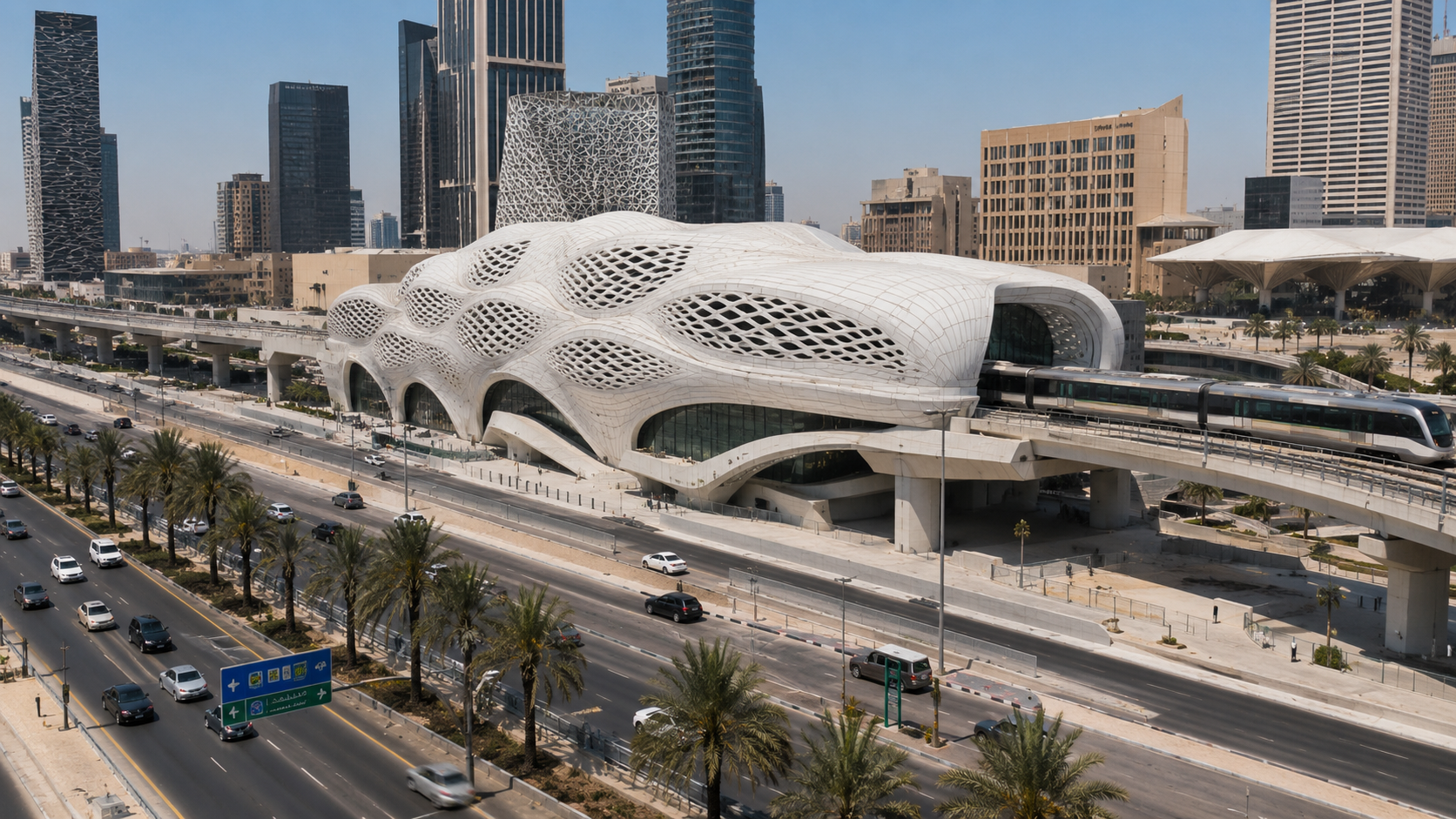
Riyadh Metro has changed how the capital’s property market is priced. Distance to the nearest station now sits alongside district and unit size in what buyers weigh, and the effect is already measurable: within a single district, homes near stations have grown in value at a different rate from those on its outer edges.
The station itself does not create value. Three mechanisms do.
A King Saud University study of the KAFD station recorded a 15 to 30 percent rise in vertical residential density, alongside a shift toward mixed-use.
Knight Frank’s 2025 analysis identified what it called a metro premium, comparing price growth near stations with growth in the same district’s outer areas.

Source: Knight Frank, 2025 (Q2 2023 – Q2 2025).
The same research estimates that 1.5 million of Riyadh’s 8.3 million residents live within a 15-minute walk of a station. King Saud University puts the uplift at 10 to 25 percent in market and rental value within 400 to 800 metres. The pattern is consistent: the gap widens in districts that were poorly connected before the metro, and narrows in established ones.
Dubai is the closest comparable market. Its metro has run since 2009, and its transaction data has been studied academically. The findings are less uniform than the headlines suggest.
JLL puts the walking-distance premium at between 5 and more than 25 percent, with high-density communities gaining far more than villa communities. The lesson for Riyadh: proximity pays, but sitting on top of a station does not.
CBRE recorded a premium of around 20 percent on homes near Elizabeth Line stations — and it materialised after the project was approved, well before services began in 2022. Over a longer window, prices near stations rose 80 percent between 2008 and 2023 against 74 percent in the surrounding areas: a net premium of six percentage points.
The takeaway is about timing. Most of the gain lands between announcement and opening, not after. That puts announced Riyadh Metro extensions, including the Red Line expansion toward Diriyah, in the window investors are watching now.
The districts that gain the most share three traits: density with room to grow, proximity to employment hubs, and weak connectivity before the metro.
Low-density villa communities gain less, since residents there still commute by car. Sitting on a metro line is not enough on its own — what matters is genuine walking distance to a station.
Evidence from comparable markets points one way: the metro effect is stronger on commercial property. Stations generate concentrated daily footfall, which serves retail and offices far more directly than a residential unit. That shows up in three places.
Residential remains less volatile and easier to exit. There, the metro effect shows as faster letting and firmer rents rather than a sharp price jump.
Expo 2030 will run on a six-million-square-metre site north of the capital, next to King Salman International Airport, with more than 40 million visits expected. Expo 2030 Riyadh Company estimates a GDP contribution of around SAR 241 billion during construction and roughly 171,000 direct and indirect jobs.
Both forces push the same way. Metro access determines how easily a district is reached; Expo determines how many people need to reach it. North Riyadh corridors close to both carry the strongest case. The usual caution applies to any event-led cycle: judge an asset on net yield and clear title, not projected price.
Riyadh continues to grow on the back of Vision 2030 and Expo 2030, and demand has followed into districts served by the network. Currently available through Mada Properties:
The Riyadh Metro effect on property values is real, but selective. It widens in mid-priced districts, narrows in established ones, and favours commercial over residential. Most of the growth arrives before a line opens, which makes timing the decisive variable.
Speak to the Mada Properties team for a recommendation built on market data rather than assumptions.
August 27, 2026
Milan hosted Expo 2015 for just six months. A decade later, the effect is still visible in its property prices and transaction volumes. For anyone watching Riyadh prepare for Expo 2030, that makes Milan worth a closer look.
Here is what happened in the Milan market before and after the event, and what Saudi investors can take from it.
Milan entered its hosting period still recovering from the 2008 crisis, with home prices around 30% below pre-crisis levels. Momentum built as the event approached: residential sales rose roughly 6.8%, and the city climbed from 24th to 12th in PwC's European city attractiveness ranking.
The fairground, northwest of the city in the Rho-Pero area, later became the Milan Innovation District, home to a hospital, research centres, a university campus and housing. Neighbouring areas felt it directly: in Cascina Merlata, beside the site, the average price per square metre rose from EUR 2,776 to EUR 3,993, up 44%, with transactions up 78%.
Activity moved before prices did. Between 2015 and 2021, residential transactions rose 48.2%, retail sales 60.5%, and offices jumped 179.7%. Rents in the city centre climbed around 40%. Prices rose 30% to 40% overall from 2015, and by 2022 sales volumes were double their pre-Expo level, with selling times halved.
Riyadh will host Expo 2030 in the north of the city, where the supporting infrastructure is already under construction. The early-entry window here is shorter than Milan's was.
A global event does not lift a market evenly. It lifts the locations the new infrastructure actually serves, which is where a professional broker earns their place.
At Mada Properties we track where value is forming and recommend accordingly. Let's talk about north Riyadh.