Dec 9, 2025
When considering a move to a new district, one doesn't just search for an address on a map; they seek a comfortable beginning, a sense of stability, and a place that reflects the lifestyle they desire. For this very reason, the name Al Rabwah District Riyadh frequently comes to mind for many seeking a home or an investment, especially those wanting to combine proximity to the heart of the capital with the comforting quiet of a fully-integrated family district.
You likely arrived here because you are searching for the Rabwah Riyadh location, wondering if Al Rabwah is truly upscale as they say, asking about Al Rabwah district exits in Riyadh, or perhaps planning to know the price per meter in Al Rabwah Riyadh before making a decision to buy or rent a property.
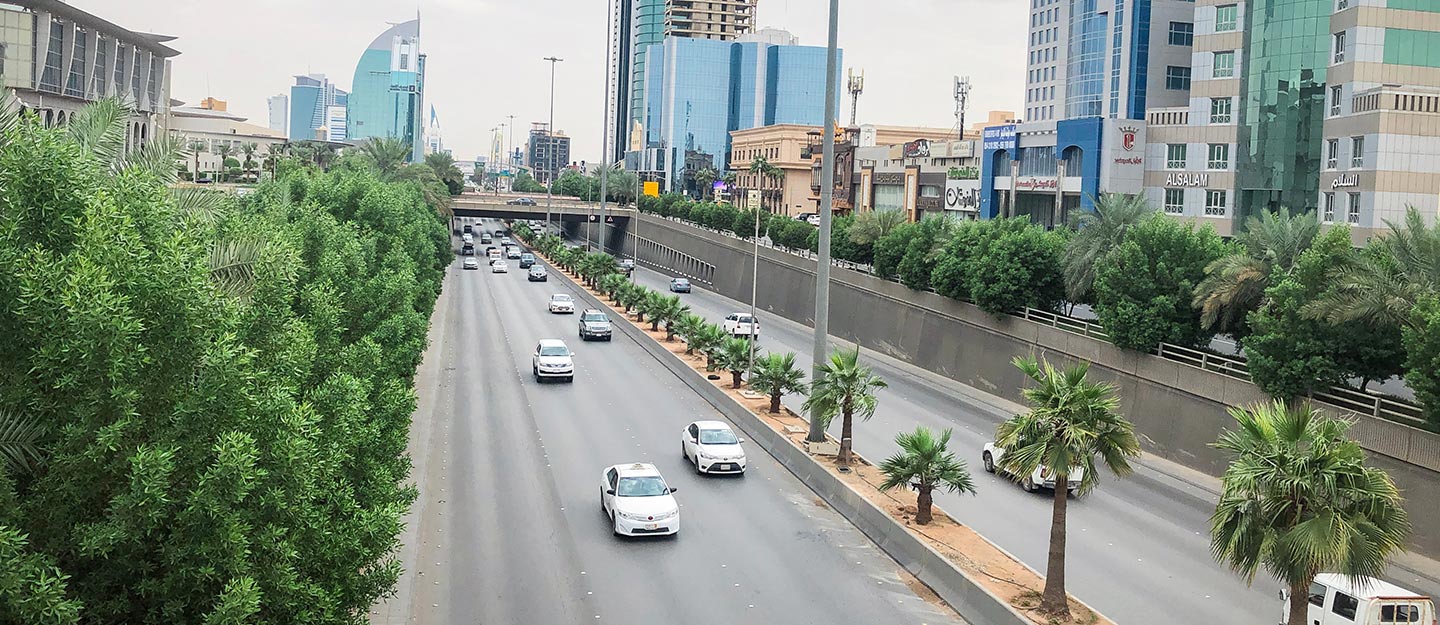
When discussing any residential district, location remains the primary element determining its value. Al Rabwah District in Riyadh possesses a unique location that brings it closer to the city center despite being classified within East Riyadh. This distinction provides residents with high mobility and smooth access to main roads.
The district is situated among some of the most important traffic networks in the city and is characterized by its proximity to the following key routes:
This strategic location has made it an attractive area for a wide range of families, employees, and business owners, particularly those looking for a residential point close to most governmental and public facilities.
Al Rabwah District is distinguished by its strategic location amidst a group of important residential neighborhoods in the capital. It is bordered by Al Rawabi and Al Rayan districts to the east, and Al Zahra district to the west. To the south, it is near Al Safa and Jareer districts, while King Abdulaziz district neighbors it to the north. This diversity of surrounding neighborhoods enhances Al Rabwah's value and makes it a distinguished choice for living and investment.
The district is directly connected to one of the most important exits of the Eastern Ring Road:
Al Rabwah Riyadh Exit 14
Another frequently asked question is:
What is the exit for Al Rabwah District in Riyadh?
The definitive answer: Exit 14, in addition to utilizing the adjacent Exit 15.
This connectivity allows residents to move quickly towards areas like Khurais Road, Makkah Road, and the city center, significantly reducing daily commute times and making the district a comfortable choice for employees across various sectors.
Many clients ask: Is Al Rabwah a luxurious district?
According to Mada Properties analysis, the district can be described as:
In other words, the district doesn't belong solely to the category of luxury districts but combines practicality, balanced prices, and high investment value.
The district is witnessing increasing demand for various types of real estate, whether for family living or long-term investment. Mada Al Aqariyah focuses on this district because it combines:
This makes searching for properties for sale in Al Rabwah a reliable choice for buyers looking for a safe area for price growth in the coming years.
Thanks to its vital location and connection to main roads, the district has become a desired destination for those seeking:
Mada Properties works to connect clients with suitable offers according to their needs and budgets, whether they are looking for a residence or wish to enter the real estate market for sale in East Riyadh.
The most prevalent property types within the district:
The price per square meter in Al Rabwah Riyadh forms an important indicator for those wishing to invest or own in this upscale district. The average price per meter for residential land is approximately 3,016 Saudi Riyals, making it a suitable choice for those wanting to build their own homes or for long-term investment. As for villas, the average price per meter is about 4,876 Saudi Riyals. This price reflects the quality of finishes and facilities provided by residential projects in the district.
It is worth noting that the final price of any property depends on several factors, including the precise location within the district, plot size, and property type (whether land, independent villa, or apartment). This diversity in prices gives investors and buyers multiple options to suit all budgets and residential aspirations, confirming Al Rabwah's position as one of the most attractive districts in East Riyadh in terms of real estate investment.
The availability of services in the residential surroundings represents one of the most important reasons for choosing a district. Al Rabwah District is distinguished by the integration of its services across almost all sectors:
The district includes more than 60 educational institutions, including:
The district boasts a group of parks and recreational centers such as:
All these features make the district suitable for families seeking a comfortable and safe environment.
One of the most important factors making the district an excellent residential choice is the availability of large shopping centers like:
Local and international restaurants are also available, making daily life easy and convenient for residents.
The district is considered one of the most connected to the capital's main arteries. The presence of:
helps reduce travel time to main areas like Al Olaya, Al Malaz, Khurais, and the Airport.
Al Rabwah District Riyadh is one of the most prominent investment areas in the east of the capital. It is distinguished by its strategic location within the Al Malaz municipality, near districts like Al Rawdah, Al Naseem, Al Sulay, Al Salam, Al Khalij, Al Rimal, Al Yarmouk, and Al Nuzha, making it a beating heart of distinctive real estate opportunities. Investing in this area gives those wishing to live or invest commercially diverse options from residential and commercial projects that meet various needs. Among the most prominent nearby projects:
Starting price from 995,000 SAR. Gray Hills is a luxurious project combining modern design and advanced facilities to offer a lifestyle reflecting high taste and privacy in a quiet environment.
Starting price from 1,200,000 SAR. Bayt Al Nayef 2 Includes luxurious apartments with elegant designs and multiple floors, providing a community with integrated services, ideal for families seeking comfort and quality.
Starting price from 2,400,000 SAR. Masaken view offers modern villas with wide spaces and luxurious finishes, with integrated facilities close to schools and vital services.
Starting price from 795,600 SAR. Avenue 60 | 1027 is a commercial project with carefully designed showrooms, in a strategic location giving investors the opportunity to achieve rewarding returns in an advanced commercial environment.
The multiplicity and diversity of projects in East Riyadh make Al Rabwah District and its surroundings among the preferred investment destinations for anyone looking for upscale living or an investment with guaranteed returns.
Choosing the right property doesn't just depend on a good location or a competitive price, but first on a trusted entity capable of providing accurate and realistic options. This is where the role of Mada Properties stands out as a real estate marketing company that relies on transparency and provides integrated solutions for those searching for properties for sale in Al Rabwah or in East Riyadh more broadly.
The company operates according to a vision based on analyzing client needs and presenting the most suitable property for them, whether they are looking for long-term investment or stable family housing. Mada properties also possesses an extensive network of documented residential and commercial units and strives to provide detailed information about the price per meter in Al Rabwah Riyadh, the available property patterns, and the advantages of each area, to ensure a studied decision based on accurate data.
Choosing Mada Properties means dealing with a specialized team with deep experience in the Riyadh market, giving you a real estate experience based on trust, clarity, and real results.
Al Rabwah District Riyadh remains one of the most in-demand districts in the capital thanks to its vital location, integrated services, and connection to a network of main roads that make reaching any destination within Riyadh much easier. Accurate knowledge of the Al Rabwah District Riyadh location, knowing what is the exit for Al Rabwah District in Riyadh, in addition to tracking price movements and the price per meter in Al Rabwah Riyadh, are all elements that help the seeker make the right decision, whether for purchase or investment.
With the accelerating urban development in East Riyadh and the increasing demand for real estate there, resorting to a professional entity like Mada properties remains a smart step for anyone who wants to get the best available opportunities with the highest quality and best value. Al Rabwah is not just a place to live; it's a balanced lifestyle combining vitality and comfort, quiet and proximity to the capital's most important destinations.
Al Rabwah District is located east of Riyadh city, directly connected to the Eastern Ring Road. It is also known for its proximity to Exit 14 and Exit 15.
The district is located near Exit 14 on the Eastern Ring Road, which is the most famous exit to reach it.
Yes, Al Rabwah is considered one of the mid-to-upscale districts in East Riyadh, characterized by quiet and diverse services.
Its vital location between east and central Riyadh, and the multiplicity of surrounding roads such as Makkah Al-Mukarramah Road and Al Nahda Road.
Yes, diverse options are available including apartments, villas, and land plots, with great diversity in spaces and prices.
Stay informed with expert-written articles and the latest trends in the real estate market.
October 26, 2026
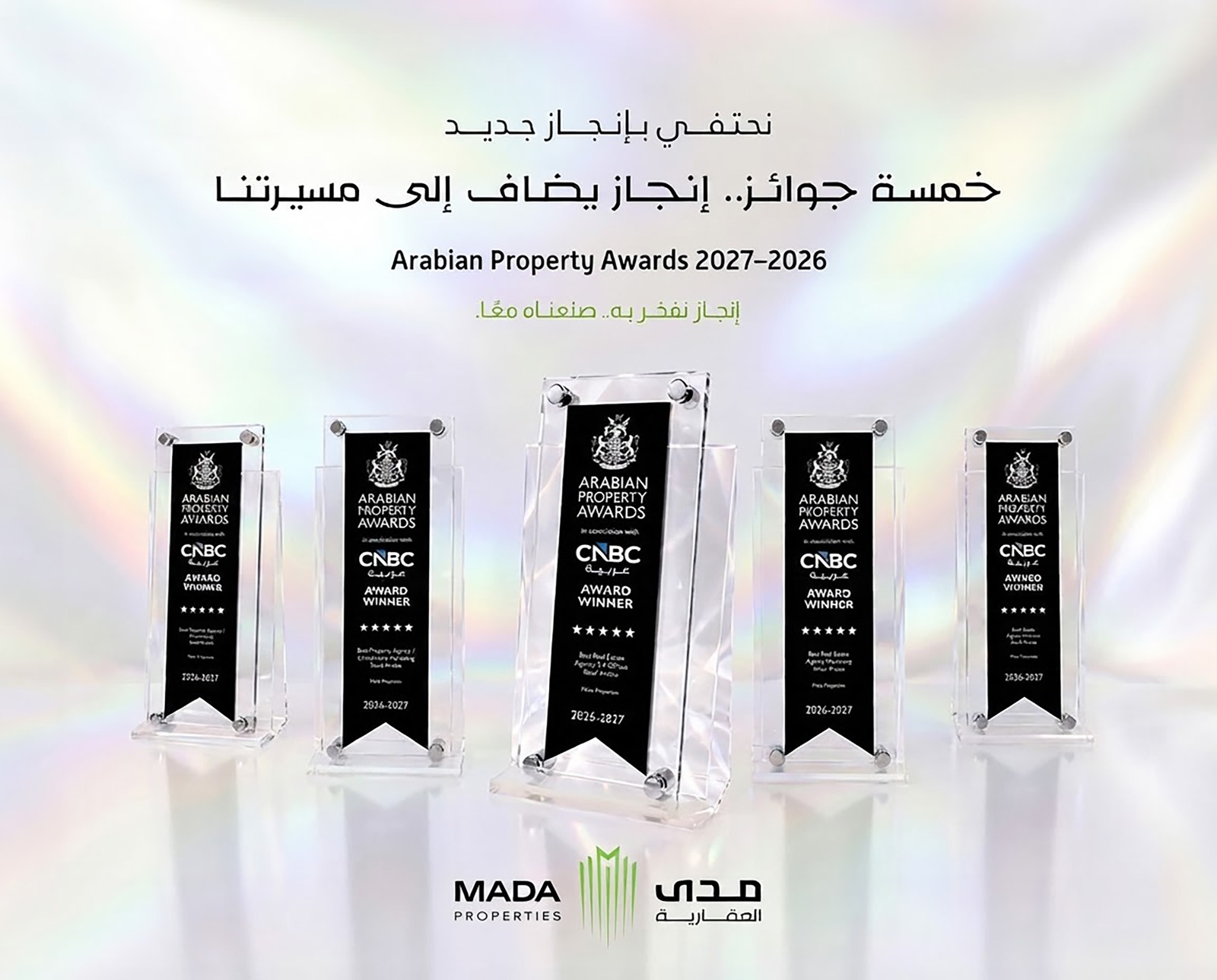
Mada Properties has won five awards at the Saudi Arabia Property Awards 2026-2027, the Saudi categories of the Arabian Property Awards presented in association with CNBC Arabia, each carrying a five-star rating.
The five awards cover the real estate agency, property consultancy, real estate marketing and the agency website. They extend a record that began in the 2023-2024 season with a single category and has grown in every season since.
This article explains what the awards are, how they are judged, what each of the five awards recognises, and how to verify any real estate company's awards before you rely on them.
The Saudi Arabia Property Awards are the Saudi categories of the Arabian Property Awards, which are part of the International Property Awards run by International Property Media in the UK. The awards recognise excellence in real estate, development, architecture, interior design and marketing, in both the residential and commercial sectors, with a focus on service, sustainability, originality and creativity.
The organiser announced a category named "Saudi Arabia Property Awards" and described it as the first global real estate award named after the Kingdom. Entrants apply at national level, a panel of experts judges the entries, and winners are invited to the awards ceremony and may use the award logo in their marketing. That is why Mada's trophies carry the words "Saudi Arabia" after each category name. Top winners in each region then go forward to the international awards.
All five trophies carry the Arabian Property Awards mark, the words "in association with CNBC Arabia", a five-star rating and the 2026-2027 season.
This category is for real estate agencies running between two and four offices. Mada publishes four office addresses in Riyadh: As Sahafah, Al Aridh, Al Rimal and Olaya Street.
A category that combines brokerage and advice. It matches what Mada does when it compares the options on the market and recommends districts and projects according to the client's goal, which is the role of a property consultancy.
This award covers the marketing of a real estate agency. Mada states in its articles that its marketing rests on reading the market, analysing data and reaching the right client.
The marketing category for agencies and advisory firms.
This one concerns the agency's website. Mada's site brings together projects, districts and articles, and a mobile app carries the same content.
See the record of earlier awards on Mada's Awards & Recognition page.
The organiser states that the awards are judged by an independent panel of more than 100 industry experts, chaired by members of the UK House of Lords. Judging focuses on:
The path to an award has five steps:
The 2026 Arabia Property Awards celebration takes place on 5 November 2026 in the House of Lords, London, as a private event for a select number of award-winning companies, according to the event website.
According to Mada's Awards & Recognition page and blog:
The pattern is clear: from one category to five in four seasons. But every season is judged separately, so an earlier award does not replace a look at the current one. For a wider reading of what these awards mean for an investor, see our article on Mada's award success story.
There is no official list that names the best real estate agency in Saudi Arabia, and awards are one signal among several. Whether you want a top real estate consultancy or a brokerage, ask:
A real estate agency handles brokerage and client service from advice to closing, while real estate marketing focuses on reaching clients and showing a project's value. That is why the awards separate the agency category from the marketing category, and Mada won both this season.
Choose an agency that works as a broker, not a developer: it compares projects for you instead of promoting its own.
Mada won two marketing categories this season. From the client's point of view, good marketing shows up in three ways:
We explain our approach in our guide to the best real estate agency in Saudi Arabia.
Many companies display award logos. Checking one takes minutes:
An award assesses a company's performance, while licensing is a legal requirement to operate. A five-star award and a brokerage licence are different things: the first goes to those who excel, the second is something nobody can operate without.
Check the broker's Fal licence, and the licence of the listing, with the Real Estate General Authority before any payment, then look at the awards.
Mada Properties is a professional real estate broker, not a developer, so we start from your goal, not from a project we own. We read the market, compare the options on Mada's projects page and stay with you to closing. The five awards recognise that approach, but they do not replace checking for yourself. Contact us and we will recommend what suits your budget and goal.
The Saudi Arabia Property Awards give clients an independent signal they can verify, provided you read it as it is: a category, a season and a level. Mada Properties holds five five-star awards in 2026-2027, but a good property decision starts with the licence, passes through comparison and is settled with numbers.
October 21, 2026
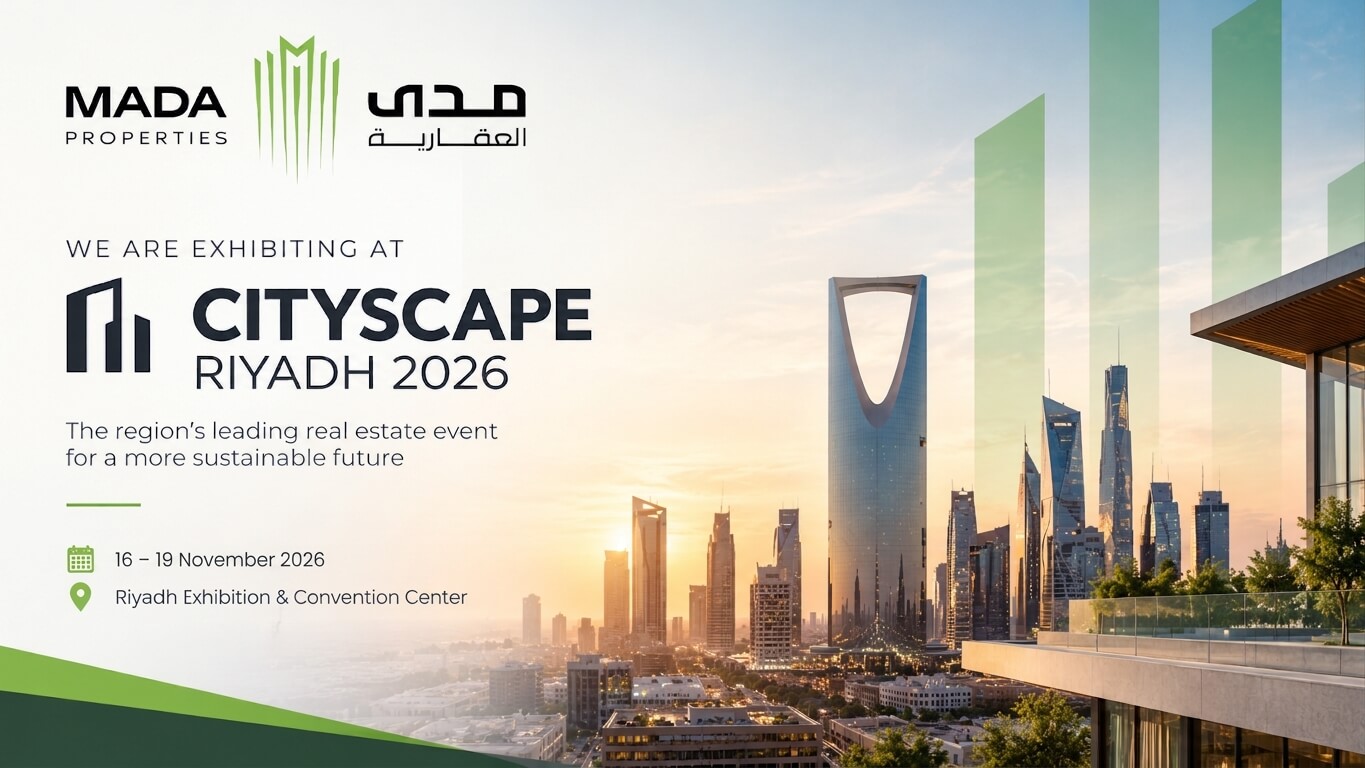
Cityscape 2026 Riyadh runs from 16 to 19 November at the Riyadh Exhibition & Convention Center (Malham), bringing developers, investors, banks and real estate decision-makers together for four days of project launches and deal-making.
The 2025 edition alone announced real estate deals worth SAR 237 billion in four days. That is why Cityscape is no longer only for developers: individual buyers and small investors now attend to see opening prices and payment plans before they reach the open market.
This guide covers what visitors look for most: the Cityscape 2026 date and venue, the exhibitor list, projects and offers, tickets and registration, how to get there, and how to prepare.
Cityscape 2026 Riyadh is the 2026 edition of Cityscape Global, which its organisers describe as the world's most attended real estate exhibition. It is organised by Tahaluf in partnership with the Real Estate General Authority (REGA), and this year's slogan is "The Capital of Real Estate".
The show in numbers:
It arrives months after Saudi Arabia's non-Saudi property ownership law took effect on 22 January 2026, which widened interest from abroad.
The Cityscape 2026 date is Monday 16 to Thursday 19 November 2026. Doors open to visitors from 12:00 pm to 10:00 pm every day.
The venue is the Riyadh Exhibition & Convention Center (Malham) in north Riyadh, about 30 km from King Khalid International Airport according to the organisers. Visitors often call it "Cityscape Malham".
The official exhibitor list is published on the Cityscape Global website and updates until the show opens. Confirmed so far:
Do not rely on the list alone: new launches may be announced during the show, so follow the show's and developers' channels across the four days.
The official ticket page describes mortgage solutions, ownership options and payment plans offered directly by developers and banks. In practice, Cityscape projects and offers come in three forms:
At the 2025 opening, Minister Majed Al-Hogail said real estate loans to individuals and companies reached about SAR 961 billion by Q2 2025 and citizen home ownership passed 65% at end-2024.
A show offer is not always the cheapest price in the market. Ask before you book:
Cityscape Riyadh 2026 offers three ticket categories: General, Business, and VIP. Each pass provides different benefits to suit visitors' needs, from exploring the exhibition to enjoying exclusive networking opportunities and premium hospitality services.
The General Pass is available free for a limited time, reduced from SAR 100. The offer ends on 15 November 2026. Benefits include:
The Business Pass costs SAR 2,438, including 15% VAT, reduced from SAR 3,000. It includes all General Pass benefits, plus:
The VIP Pass costs SAR 9,377, including 15% VAT, reduced from SAR 11,253. It offers a premium event experience with exclusive benefits, including:
The right ticket depends on your goals and budget. The General Pass is ideal for visitors exploring real estate opportunities, while the Business Pass suits professionals seeking networking opportunities and business services. The VIP Pass is designed for visitors who prefer exclusive access and premium hospitality.
Note: Ticket prices, promotional offers, and availability may change. Check the official Cityscape Riyadh 2026 ticketing page before registering.
To register: open the official ticket page or register by WhatsApp, choose a pass, enter your details exactly as on your ID (the pass is linked to your badge), pay by credit card if the pass is paid, then wait for the confirmation and badge emails. Each participant gets one pass only, fees are non-refundable and non-transferable, and accommodation and meals are not included.
The 2025 edition announced SAR 237 billion in deals over four days, including SAR 161.2 billion in the first two days. It also reported a 166,000 m² site (double 2023), 42 countries represented including 15 new ones, USD 6.1 trillion of real estate and infrastructure assets under management, 350+ investment meetings and 164,000+ attendees from 120+ countries.
Mada Properties is a professional real estate broker, not a developer, so we show you options as they stand in the whole market, not as a single developer presents them. Around a show, when offers and quick bookings pile up, a neutral broker compares launches with similar projects outside the show, checks the project's legal status and stays with you to closing. Contact us to compare what you see at the show with what is available today.
Cityscape 2026 Riyadh is the biggest chance this year to see the Saudi property market in one place: what will be launched, at what price and on what payment plan. It rewards visitors who arrive with a plan. Set your goal and budget before 16 November, register early, ask for every offer in writing and compare before you book.
August 27, 2026
Mortgage lending in Saudi Arabia operates inside a defined regulatory framework set by the Saudi Central Bank (SAMA), with each lender layering its own credit policy on top. The practical consequence is that eligibility, and the amount you can borrow, are not a verdict handed down at the branch. They are figures you can work out in advance.
That matters, because most property purchases in Riyadh today are financed over fifteen years or more, and the size of the financing available is what sets the range you can realistically shop in, not the other way round.
Real estate financing is an amount advanced by a bank or a finance company licensed by SAMA to buy a residential property, repaid in monthly instalments that typically run from fifteen to thirty years. The property is registered as security in the lender’s favour until the balance is settled in full.
One point of terminology worth clearing up early: in the Saudi market, "home loan," "mortgage" and "real estate financing" all describe the same thing. The meaningful difference is structural, most products offered in the Kingdom are built on Sharia-compliant contracts rather than interest-bearing lending, which is why you will see profit rates quoted rather than interest rates.
The contract structure varies between lenders. Three are common:
The difference between these is not just nomenclature. It affects when title passes to you, how early settlement is treated, and how insurance is handled. Ask which structure applies to your offer before you sign, not after.
Requirements are broadly consistent across lenders in the Kingdom; what varies are the thresholds:
Four of these decide the outcome more than the rest. They are worth taking in turn.
A complete, internally consistent file shortens the assessment and reduces the chance of rejection. Most lenders ask for:
Check that the details match across documents. A salary figure or employer name that reads differently on the salary certificate than on the bank statement is a routine cause of delay.
The Sakani programme, delivered with the Real Estate Development Fund (REDF), provides support to eligible Saudi nationals, including coverage of part of the profit margin up to a defined financing ceiling. General eligibility conditions:
The financing track adds further conditions: a minimum monthly income, a defined age band, the property being your first home, and an acceptable credit standing.
One point that is regularly missed: eligibility is determined through the Sakani platform, not by the bank. You can meet a lender’s commercial criteria and still fall outside the support criteria, or the reverse. Figures and ceilings are revised periodically, so use the official eligibility calculator rather than numbers quoted second-hand.
Financing is available to non-Saudis, on more conservative terms:
The wider ownership picture changed in 2026. Royal Decree M/14 took effect on 22 January 2026, consolidating non-Saudi property ownership under a single framework, and the Council of Ministers approved the executive regulations and the designated geographic zones in June 2026. Those zones include Riyadh. Because the rules are recent and documentation is still being published, confirm the current position before committing funds.
There is no single best lender, because the right one depends on your employment sector, where your salary is paid, and the type of property. The market offers three categories of provider:
Rather than looking for a ranking, compare offers on five points:
Because pricing and promotions shift, request written offers from more than one provider and compare them on the same day. That is the most reliable way to identify the best option for your particular position.
Most rejections come down to causes you can address before you apply:
A rejection is rarely final. Ask for the reason in writing — it tells you precisely what to fix before the next attempt.
Termination is governed by the terms of your contract and by SAMA regulation. Three situations account for most cases:
Termination is not the same as refinancing. Refinancing moves your existing facility to another provider on better terms while the obligation continues; termination ends the contractual relationship. Read the early settlement clause and its associated fees before you sign, and if you cannot reach a resolution with your lender, a complaint can be raised through SAMA’s official channels.
Mortgage requirements in Saudi Arabia are transparent and verifiable in advance, and the most common mistake is searching for a property before establishing borrowing capacity. The productive order is the reverse: calculate your debt burden ratio, review your SIMAH record, check your eligibility on Sakani, then search within the range that is actually open to you.
Once you're ready, speak with the Mada Properties team for expert guidance based on current market insights.
On a SAR 8,000 salary with no existing commitments, the maximum monthly instalment could reach roughly SAR 4,400 at a 55% debt burden ratio. The corresponding financing amount depends on the repayment term and profit rate offered, which is why the result differs between lenders.
Yes, on more conservative terms — a higher down payment and a repayment term tied to your iqama and employment contract. Sakani and REDF support is not available to non-citizens. Ownership itself now falls under Royal Decree M/14, in force since 22 January 2026, within designated zones that include Riyadh.
Indicative limits run between 55% and 65% of monthly income depending on borrower category and lender policy, and all existing commitments count towards it. Check SAMA’s responsible lending principles for the current position, as they are updated periodically.
SAMA raised the maximum loan-to-value ratio on a first home for Saudi citizens to 90%, putting the minimum down payment at 10%. It falls further on subsidised tracks for properties below a defined value ceiling.
Most products offered in the Kingdom are structured on Sharia-compliant contracts — commonly Murabaha or Ijara Muntahia Bittamleek — rather than interest-bearing lending, which is why lenders quote a profit rate rather than an interest rate.